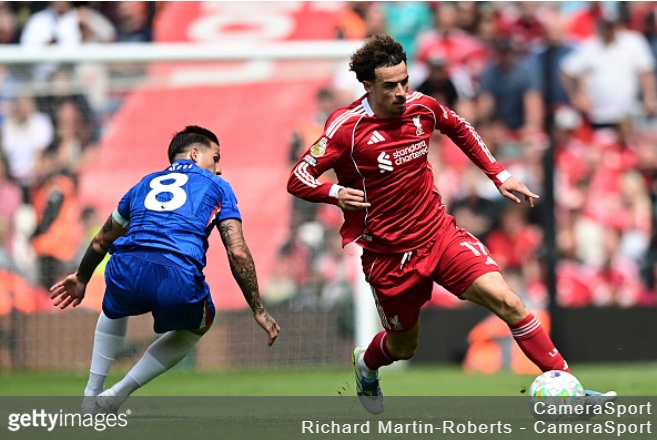
A game that promised clarity instead produced unease. Liverpool’s 1–1 draw with Chelsea at Anfield on Saturday encapsulated a season drifting between control and hesitation.
Ryan Gravenberch’s early strike suggested a routine victory against a struggling opponent, but Enzo Fernández’s equalizer and a listless second half left more questions than answers. It was a result that neither side fully embraced: Chelsea halted a bruising losing streak, while Liverpool, once again, failed to capitalize on opportunity and momentum.
Lineups and Absentees
Arne Slot’s selection reflected both necessity and experimentation. Liverpool lined up in a 4-2-3-1 with Giorgi Mamardashvili in goal, a back line of Curtis Jones, Ibrahima Konate, Virgil van Dijk and Milos Kerkez, and a midfield anchored by Ryan Gravenberch and Alexis Mac Allister. Dominik Szoboszlai operated ahead, flanked by Jeremie Frimpong and teenager Rio Ngumoha, with Cody Gakpo leading the line.
Chelsea mirrored the shape, deploying Filip Jorgensen behind a defensive trio of Levi Colwill, Wesley Fofana and Jorrel Hato. Wing-backs Malo Gusto and Marc Cucurella provided width, while Moises Caicedo and Andrey Santos patrolled midfield. Further forward, Cole Palmer and Enzo Fernandez supported Joao Pedro.
Both teams were missing key figures. Liverpool’s absentees included Mohamed Salah, Alisson Becker and Florian Wirtz, limiting attacking fluidity and experience. Chelsea, meanwhile, arrived depleted, without Robert Sanchez, Pedro Neto, Alejandro Garnacho and several wide options, contributing to their cautious, improvised attacking structure.
The Course of the Match
The match began with urgency from the hosts. Within six minutes, Liverpool capitalized on a set-piece scramble as Ngumoha teed up Gravenberch, who curled a superb strike into the top corner. It was a vivid reminder of Liverpool’s latent quality and hinted at a straightforward afternoon.
Yet the familiar pattern soon unfolded. Instead of building on their lead, Liverpool retreated, allowing Chelsea to settle into possession and confidence. Cucurella repeatedly found space down the flank, while Cole Palmer began dictating tempo. The equalizer, when it arrived in the 35th minute, felt inevitable: Fernandez’s free-kick evaded all contact and crept inside the far post, restoring parity before halftime.
The second half offered sporadic intensity but little cohesion. Both sides briefly believed they had scored go-ahead goals—Palmer for Chelsea and Curtis Jones for Liverpool—only for VAR to intervene with offside decisions. Liverpool, belatedly reenergized, struck the woodwork twice through Szoboszlai and Van Dijk, yet lacked the precision and conviction required to break Chelsea’s resistance.
What lingered was not drama but drift—a contest neither team seized, reflecting two campaigns weighed down by inconsistency.
A Snapshot in Numbers
Statistically, the balance reflected the narrative.
Liverpool recorded eight shots to Chelsea’s six, with both sides managing three on target. Possession was nearly even, tilting slightly in Chelsea’s favor at 51 percent.
Expected goals were also closely matched, emphasizing how few clear opportunities either side created despite spells of territorial dominance.
Discontent and Doubt at Anfield
The final whistle brought not applause, but discontent. Boos rang out around Anfield, a rare and telling reaction. The loudest protest had come earlier, when Slot substituted Rio Ngumoha, arguably Liverpool’s most lively attacking presence, for Alexander Isak. The decision triggered an immediate chorus of frustration, symbolizing a widening disconnect between coach and crowd.
This was not simply about one substitution. It was about a broader dissatisfaction with Liverpool’s passivity after taking the lead and a recurring inability to assert control. Supporters, who once embraced Slot’s approach, now question his in-game decisions and overall direction. Reports described a “mutinous mood” and growing impatience, with comparisons to past managerial crises reflecting the scale of unrest.
Slot, for his part, acknowledged the reaction as a natural consequence of dropped points, insisting results—rather than sentiment—drive perception.
Yet the reality is unmistakable: a manager once buoyed by success now faces mounting scrutiny. Even if the club hierarchy continues to back him, the relationship with supporters has frayed, and rebuilding trust may prove as difficult as securing victories.
Conclusion: A Result with Consequences
This draw leaves Liverpool fourth with 59 points, still in control of their Champions League destiny but no longer comfortable. With two games remaining, they likely need at least one win to guarantee a top-five finish, a scenario that underscores the risk of dropped points in matches such as this.
For Chelsea, the point halts a six-game losing streak but does little to transform their season. Sitting well outside the European places, they remain reliant on favorable results elsewhere to salvage even secondary continental qualification.
Ultimately, the afternoon belonged to neither side. Liverpool edged closer to their objective without conviction, while Chelsea showed resilience without momentum. In a match that offered opportunity, both teams settled for ambiguity—leaving Anfield uneasy and the Premier League race for Europe still unresolved.