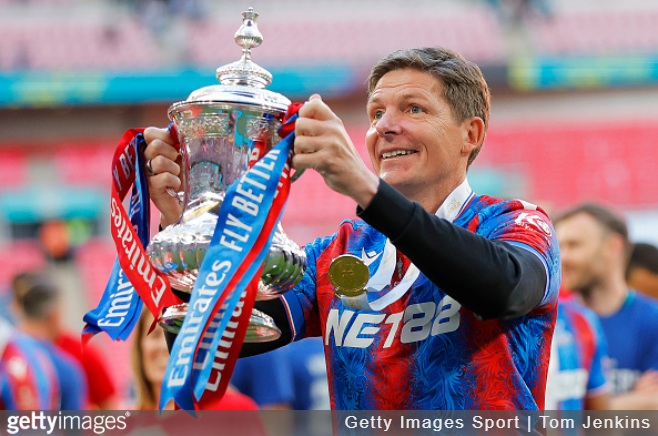
When Oliver Glasner arrived at Selhurst Park, Crystal Palace were a club searching for identity—ambitious enough to dream, but historically too modest to believe those dreams could take shape. Under the Austrian, they did far more than dream. They made history.
Glasner delivered what no manager before him had: an FA Cup trophy. The 2024–25 campaign stands as the most decorated season in Palace’s long existence, culminating in their first-ever major piece of silverware. The momentum continued as the club defeated Premier League champions Liverpool to lift the Community Shield, and even stepped onto the European stage in the Conference League—a remarkable ascent for a club long accustomed to battling mid-table gravity.
But success, as football so often proves, does not guarantee stability.
Embed from Getty Images
In the months following those achievements, the relationship between Glasner and the club’s hierarchy deteriorated dramatically. The unraveling didn’t happen overnight. It unfolded through mounting frustrations, public accusations, and an increasingly strained alignment between manager and board.
The catalyst came in the form of player sales—first Eberechi Eze in the summer, then club captain Marc Guéhi to Manchester City, announced just 24 hours before a league match. Glasner insisted he had been blindsided. He claimed the club informed him of Guéhi’s omission from the matchday squad only hours before kickoff, igniting a sense of betrayal. From that moment, he repeatedly described himself and his squad as “abandoned,” lamenting a lack of squad depth, support, and communication.
His grievances, however, did not remain internal. They spilled into press conferences—two particularly explosive ones—during which he criticized the board’s ambition, the timing of transfer decisions, and the club’s strategy. The tone was emotional, sharp, and unfiltered. His choice of words astonished executives around the league; according to reporting, some clubs even began reconsidering Glasner for future appointments because of how publicly he vented his frustrations.
The fallout at Palace was swift. Chair Steve Parish was said to be dismayed, even angered, by Glasner’s behavior, particularly the implication that the club was content merely to survive rather than compete. After the Sunderland defeat that triggered his most incendiary remarks, Glasner admitted he no longer cared whether he stayed until the season’s end. He also confirmed—seemingly to the club’s surprise—that he intended to leave when his contract expires in the summer.
That alone would have been destabilizing. But Glasner went further, framing his position as untenable and hinting that his departure could come sooner than planned. Some saw this as a principled stand. Others interpreted it as escalation. The Independent described his comments as part of a broader Premier League pattern of managers “running to the press” to force pressure onto their hierarchies.
This raises an uncomfortable but necessary question:
Is Oliver Glasner deliberately provoking the Crystal Palace board to engineer an early exit?
It wouldn’t be unprecedented. Football history is full of managers who, once disillusioned, found ways to hasten an inevitable divorce. Glasner’s actions—dramatic press conferences, accusatory language, public airing of internal disputes—fit the mold of someone who either wants change, or wants out, immediately.
And yet, the story is more nuanced than that.
Glasner admitted his outburst was emotional but insisted he had no regrets—because “that’s Oliver Glasner.” He argued that the same passion that has driven him to speak so forcefully is the same passion that brought the team together in their finest hour. His intent, he maintained, was never to attack individuals but to express his raw feelings in a tumultuous moment. He emphasized that he and Parish shared a productive, lengthy dinner after the incident, and that both remained committed to finishing the season strong.
The club, notably, has so far resisted dismissing him. Reports suggest they prefer stability and want him to see out the campaign. Sporting director Matt Hobbs held “crisis talks” to calm tensions, and a temporary truce was established—with hope, perhaps optimism, that Glasner would curb the intensity of his public commentary. But even Palace insiders acknowledge his pattern: he may be measured before matches, but post-game emotion tends to override restraint.
So here Palace stand: a team shaped, elevated, and galvanized by Glasner’s leadership yet shaken by his recent conduct. A manager who brought historic success but now regularly challenges the very people who entrusted him with the club.
And here Glasner stands: a coach who transformed Palace’s fortunes, yet appears increasingly frustrated, isolated, and perhaps ready to be free of a situation he no longer finds tenable.
It is a tragic irony that the greatest manager in Palace’s history may leave under a cloud of mutual resentment instead of mutual admiration.
In the end, one truth looms largest:
Oliver Glasner has done extraordinary things for Crystal Palace. He delivered joy and history at a scale fans will never forget.
He changed the club’s trajectory. He gave them belief.
But none of that justifies the tone or frequency of his recent public attacks. Not at a club that embraced him. Not toward fans who stood behind him. Not now, when the season still hangs in delicate balance.
Emotions are part of who Glasner is—he says so himself. Those emotions fueled Palace’s rise, but they are also accelerating its fracture.
The conclusion is simple, and perhaps bittersweet:
Glasner has achieved more than anyone could have imagined at Crystal Palace—but there is no need to offend the club and its supporters in the way he is doing right now.
Embed from Getty Images