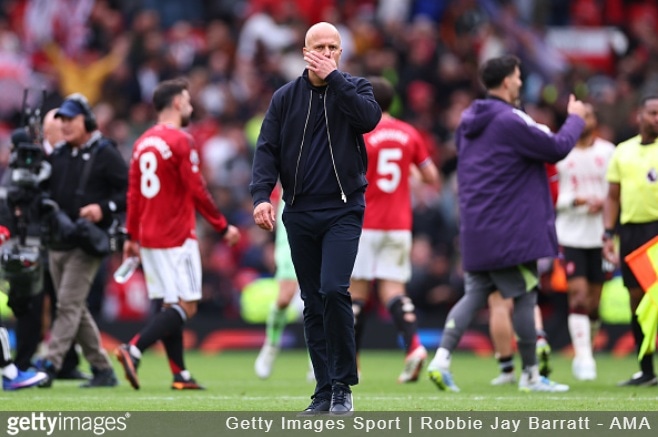
Liverpool’s defeat to Manchester United on May 3, 2026 was more than another damaging result in a season that has steadily unravelled. It was a moment of uncomfortable clarity. Not because of the scoreline alone, but because of what the match revealed — or rather, what it failed to reveal — about Liverpool’s identity under Arne Slot.
The Old Trafford Conundrum
Watching the game unfold, the difference between the two sides was notable.
Under Michael Carrick, Manchester United were not flawless, but they were coherent. They knew how they wanted to play, how they wanted to press, where they wanted to exploit space, and how to manage moments without the ball. Liverpool, by contrast, looked like a collection of players waiting for a plan that never arrived.
This has long ceased to be a one‑off concern. It is now the defining critique of Slot’s Liverpool.
Embed from Getty Images
Slot arrived with a reputation for structure, positional discipline, and proactive football. What Liverpool have instead is a team that oscillates wildly between styles without committing to any. At times they press high without coordination. At others they retreat without compactness. Possession phases lack automatisms, while transition defence is reactive rather than organised. Players appear unsure whether to hold shape or take initiative — a classic symptom of tactical ambiguity.
United, for all their imperfections this season, looked like a team that understood its own limits and strengths. Liverpool looked like a side still searching for a framework, so late in the season, against well-organised opposition. That is unacceptable at this level.
Yes, Benjamin Sesko’s goal probably should’ve been ruled out for handball, as Slot pointed out after the match, but that’s no excuse. Liverpool did not deserve anything from the game.
Issues Persist Through the Season
The consequences are measurable. Eighteen defeats in all competitions, a tally that Liverpool have not approached in a very long time, speak to something systemic rather than incidental. Injuries can explain some of it. Squad turnover can explain more. But not all of it. Teams with fewer resources and thinner squads have shown greater tactical cohesion than Liverpool managed against United. Losing games is one thing; losing them without conviction or direction is another.
Slot’s defenders will argue that this is a transitional season, that patience is required. That argument becomes harder to sustain when regression replaces evolution. Liverpool are not failing while building something recognizable. They are failing while looking unfinished, unsure, and often incoherent.
Embed from Getty Images
Slot’s midseason fallout with Mohamed Salah only amplifies those concerns. Public disputes between a manager and a senior player of Salah’s stature rarely occur in isolation. They usually point to deeper fractures — breakdowns in communication, authority, or mutual trust. While no dressing room is ever perfectly harmonious, effective managers absorb tension without letting it spill into the public domain or affect selection logic. The Salah episode felt less like isolated frustration and more like a warning flare, and the iconic Egyptian will now leave Anfield this summer.
That matters, even though Salah’s individual form hasn’t been anywhere near the level of previous campaigns, because the 33-year-old has been more than just a forward for Liverpool. He has been a constant, an emotional and technical reference point. A manager struggling to align such a figure risks undermining their own authority, especially in a squad already short on confidence.
What About Rio?
Slot’s decision to leave Rio Ngumoha out of the starting XI at Old Trafford was equally surprising. With Alexander Isak, Hugo Ekitike, and Salah all unavailable, the match offered a rare and valuable opportunity. Not an easy one — but a meaningful one — for a young, explosive talent to experience football at its highest psychological intensity.
Still only 17, Ngumoha is understandably raw. His end product is inconsistent. His understanding with teammates needs work. And that is exactly why he needs minutes in real situations, against real opponents, with real stakes. Development does not happen in training alone, nor in brief, late cameos.
Instead, Slot opted to leave the teenager on the bench, preferring safer, more conservative options that failed to direct the match the way he’d have wanted. The decision felt symptomatic of a manager caught between developmental intent and short‑term insecurity.
Embed from Getty Images
If managers are unwilling to trust young players when circumstances demand it, the development pathway becomes strewn with obstacles, and young players tend to leave such surroundings in search of more faith in their ability. Ngumoha may not yet be the finished article, but Liverpool’s long‑term model depends on accelerating that process. Big clubs do not wait for perfection before exposure. They create it through experience.
Taken collectively, these issues paint a worrying picture. Liverpool under Arne Slot do not resemble a side building toward a defined future. They resemble a side drifting — not because individuals lack quality, but because the collective lacks conviction.
Is Change Needed?
The most troubling question is whether Slot himself fully understands how he wants this team to function. Tactical clarity is not about complexity. It is about players recognising patterns instinctively. Liverpool players currently look like they are thinking, hesitating, and second‑guessing. That is the fastest way to lose elite margins.
Reports suggest that the Liverpool board continue to back Slot, at least for now. Continuity has its virtues. Knee‑jerk reactions are rarely productive. But backing a manager should be an active, evidence‑based decision — not an act of inertia.
It’s been said that Champions League qualification would be enough for the Dutchman to keep his job for the time being and last-season’s champions are close to achieving that goal, but it’s more down to the recent failures of Chelsea, as well as the fact that five teams have a place in UEFA’s elite club competition in 2026-27, than to Liverpool’s own quality and performances.
This summer, several accomplished and stylistically distinct managers are likely to be available. Xabi Alonso, with his blend of structure and identity; Oliver Glasner, and Andoni Iraola, whose teams punch above their weight in the Premier League while maintaining clarity and aggression. These names are just examples. None represent guarantees. But all represent ideas.
That is what Liverpool currently lack most: a sense of what they are trying to become.
Backing Slot now may still be defensible. Ignoring the warning signs is not. Because results can be fixed with recruitment. Confidence can return with time. But identity? Identity must be imposed by the manager.
And right now, at Liverpool, it simply isn’t there.